Tripletex - Absence Data Import to Simployer One

Modified on Thu, 4 Jun at 3:17 PM

Overview

Simployer One can receive absence data from Tripletex (inbound). Organisations that track absences via Tripletex timesheets can import leave entries (vacation, sick leave, and parental leave) into Simployer One's Time Off module without re-entering data manually. Tripletex remains the master system for absence management. Employees request and report their absences in Tripletex, not in Simployer One. The import brings this data into Simployer One for HR reporting and compliance visibility.

The import is manual, not scheduled. The typical workflow is once per month, importing the previous month's absences after timesheets are finalized in Tripletex. Before importing, the admin previews all entries to review conflicts and unmapped codes.

Optional: hide the absence request button for employees. By default, employees can request time off in Simployer One. If your organisation uses Tripletex as the sole system for absence management, you can request to have the "Request time off" button hidden from employees. The rest of the Time Off view remains visible. Contact your Simployer representative to enable this option.


What this article covers

1. How It Works
Import flow explained
2. Prerequisites
What you need first
3. Map Absence Codes
Setup in both systems
4. Run an Import
Step-by-step
5. Import Results
Statuses and conflicts
6. Key Rules
Hours, conflicts, limits


How It Works

This is an inbound integration: absence data flows from Tripletex into Simployer One. The import reads from Tripletex's timesheet module and converts relevant entries into absence periods in Simployer One's Time Off module. Only timesheet entries with a mapped leave code are included; entries without a matching code (including working time) are not imported.

The imported data gives HR a consolidated view of absences for reporting and compliance, alongside any absences managed directly in Simployer One.

This is not a two-way sync. The absence import (inbound, Tripletex to Simployer One) and the absence export (outbound, Simployer One to Tripletex) are separate, independent processes. Each has its own direction and setup. For the export direction, see Tripletex Standard Integration - Absence Data (Export).

Inbound Absence Flow

Tripletex
timesheet entries
Import Preview
review, resolve conflicts
Simployer One
Time Off module

The import groups consecutive days with the same leave code into a single absence period. For example, if an employee reported "Vacation" for five consecutive days in Tripletex, Simployer One creates one five-day vacation period.

Only timesheet entries with a Simployer code in the Description field appear in the preview. Activities without a Description (e.g. working time) are skipped silently. Entries that do have a Description but no matching Simployer One absence type appear in the preview under Unmapped leaves types and require a code mapping before they can be imported. See Map Absence Codes for setup instructions.


Prerequisites

An active Tripletex integration configured in Simployer One (Settings > Integrations)
The Time Off module enabled in Simployer One
Admin access to Simployer One (to configure absence codes and run imports)
Admin access to Tripletex (to configure leave type codes on timesheet entries)
Absence codes mapped between both systems (see next section)
Employees in scope. The import only covers employees who were included in the integration scope when the Tripletex integration was originally configured. Employees added after setup may not appear in the import until the scope is updated.


Map Absence Codes

Both systems need matching leave type codes so the import knows which Tripletex timesheet entry corresponds to which Simployer One absence type. This mapping must be configured on both sides. The available leave types in Tripletex depend on the activity number assigned to each timesheet entry type.

Supported absence types

The import currently supports three built-in absence types:

Absence typeDescription
VacationAnnual leave / holiday (Ferie)
Sick leaveSelf-reported and certified sickness absence
Parental leaveMaternity, paternity, and shared parental leave

Other absence types recorded in Tripletex (care days, time off in lieu, custom codes, etc.) are not supported by the import at this time. Timesheet entries using unsupported types will appear under Unmapped leaves types in the preview.

In Simployer One

1
Open Time Off settings
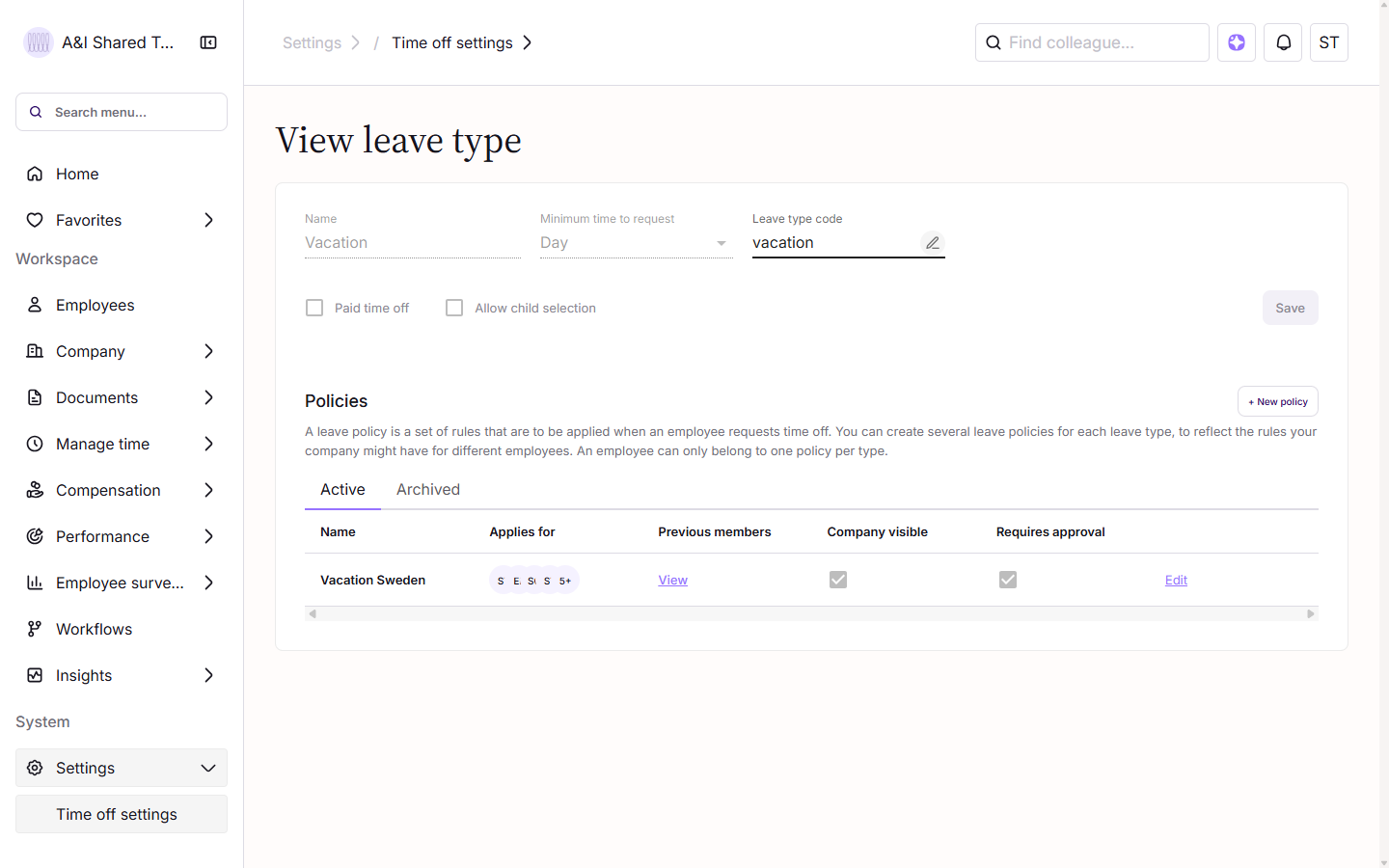
Navigate to Settings > Time off settings.
2
Add the Leave type code
For each absence type that should be imported from Tripletex, add the corresponding Leave type code. This code must match the value configured in Tripletex (see below).
In Tripletex

1
Open Timesheet settings
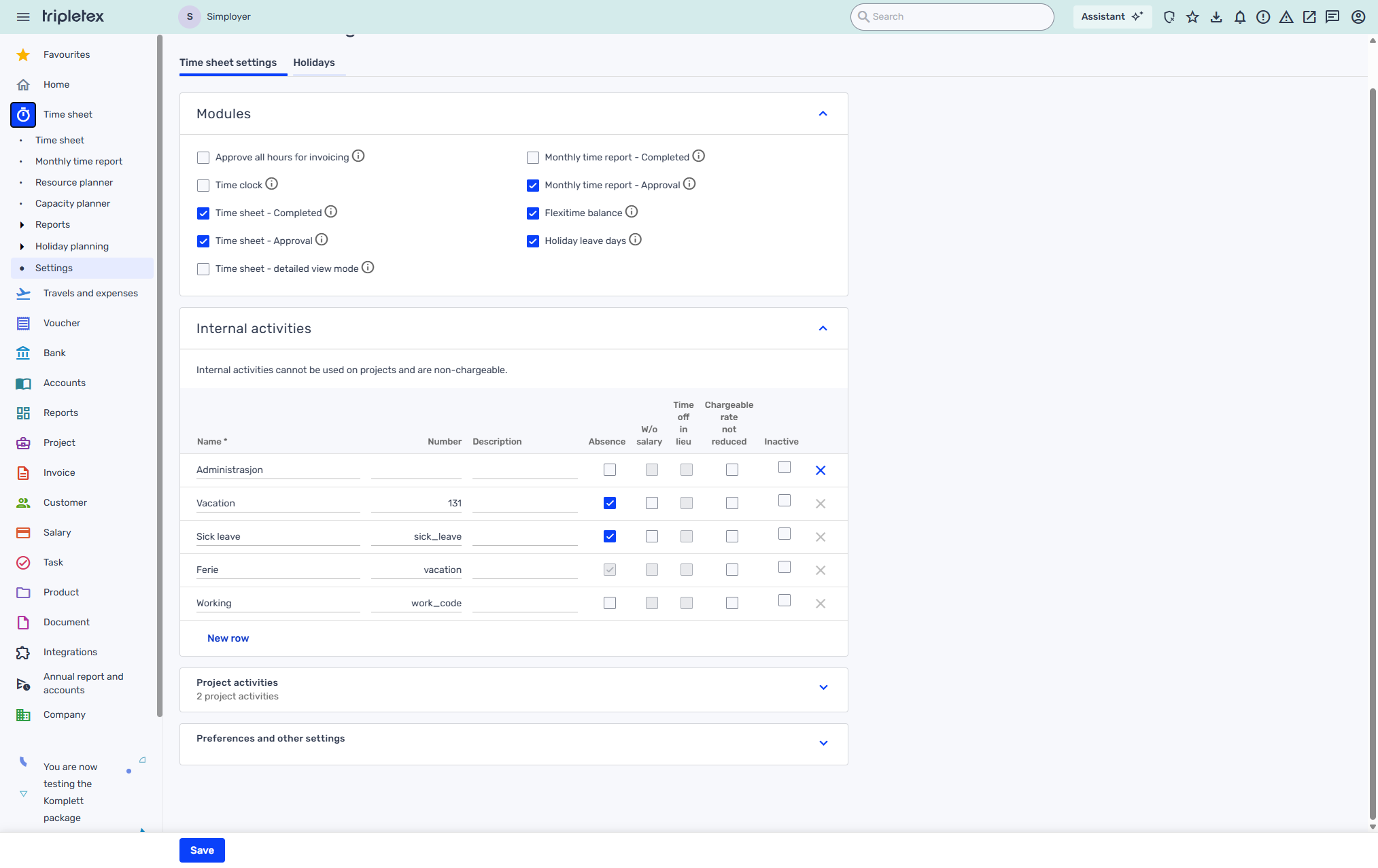
Navigate to Time sheet > Settings.
2
Add Simployer codes via the Description field
Open the Internal activities section. For each activity that represents an absence (vacation, sick leave, etc.), enter the matching Simployer leave type code in the Description field, and make sure the activity's Absence checkbox is enabled. Activities that represent working time should be left without a Simployer code in Description; they will be ignored during import.

Tip: Only map leave-type entries (vacation, sick leave, care days, etc.). Leave working time, overtime, and other non-absence timesheet entries unmapped. This ensures only actual absences are imported into Simployer One.
Note on custom absence codes: Simployer One's standard leave types (vacation, sick leave, parental leave, etc.) appear in dashboards and reporting views as expected. If custom leave type codes are used, imported absences may not appear in all aggregated reporting views. Only the built-in leave types listed above are guaranteed to aggregate into dashboards and KPIs.


Run an Import

Imports are run manually. The typical workflow is once per month, importing all absences from the previous month. The import always starts with a preview, giving the admin a chance to review before confirming.

1
Navigate to the import page
Go to Manage time > Time off - Import.
2
Select the source system
Select Tripletex from the drop-down menu.

3
Preview the import
Click Preview import. The system fetches timesheet data from Tripletex and compares it with existing absences in Simployer One. The preview groups entries into sections: Importable leaves, Already imported, Leave conflicts, Orphaned leaves, and Unmapped leaves types. A section only appears if it has at least one entry.
4
Review the results
Check each category in the preview. Resolve any conflicts before proceeding (see Import Results below for details on each status type).
5
Confirm the import
Click Confirm import to create all absences listed as "Ready to import" in Simployer One. Entries with conflicts or unmapped codes are skipped and remain unchanged.


Understanding Import Results

The import preview groups entries into categories. Each category indicates what will happen when the import is confirmed.

Section in previewMeaningAction Required
Importable leaves
Row status: Ready to import
New absence from Tripletex with no matching entry in Simployer One.None. These are imported when confirmed.
Already importedAn absence with the same type, dates, and duration already exists in Simployer One (regardless of whether it was created manually or by a previous import).None. Automatically skipped to avoid duplicates.
Leave conflictsAn absence exists in Simployer One for the same date range, but with a different type. For example: "Vacation" in Simployer One overlaps with "Sick leave" coming from Tripletex.Manual resolution. Decide which record is correct, then remove or adjust the incorrect entry in either Simployer One or Tripletex. Re-run the import afterward.
Orphaned leavesAn absence exists in Simployer One, but no corresponding timesheet entry exists in Tripletex for that period.Review and decide: remove it from Simployer One if it should not be there, export it to Tripletex using Simployer's export function, or add it manually in Tripletex.
Unmapped leaves typesA timesheet entry in Tripletex uses a Description code that has no corresponding Leave type code in Simployer One.Add the missing code mapping in both systems (see Map Absence Codes), then re-run the import.
Conflicts and unmapped types are never imported automatically. They remain unchanged until resolved. Confirming the import only processes entries from the Importable leaves section.


Key Rules and Limits

Full day vs. partial day
Timesheet entries matching the employee's full workday length (as defined in their Simployer One work schedule) are imported as full-day absences. Shorter entries are imported as partial-day absences, with the duration recorded in minutes.
Date range limit
Each import covers a maximum of 100 days. For longer periods, run multiple imports with consecutive date ranges.
Consecutive day grouping
Consecutive days with the same leave code in Tripletex are grouped into a single absence period in Simployer One, rather than imported as individual days.


Scheduling is not available. The import must be triggered manually each time. The typical frequency is once per month after the previous month's timesheets are finalized in Tripletex.


Was this article helpful?

That’s Great!

Thank you for your feedback

Sorry! We couldn't be helpful

Thank you for your feedback

Let us know how can we improve this article!

Select at least one of the reasons
CAPTCHA verification is required.

Feedback sent

We appreciate your effort and will try to fix the article